Business Systems:
What They Actually Mean

(and Why Tools Rarely Fix the Problem)
Most growing businesses don’t fail because of effort, talent, or ambition.

They stall because the system underneath the work was never designed.

The confusion starts with the word

“System”

Software
Automation
CRMs
Workflows
Dashboards
Those are tools.
A system is not what you install. A system is how work moves through the business without constant intervention.

What a business system actually is

In operational terms, a business system answers 5 questions clearly.
1.
How work enters the business
2.
Who owns it at each stage
3.
What decisions are made, and by whom
4.
How handoffs happen without confusion
5.
How visibility is maintained without manual checking
When these are unclear, the business compensates with effort instead of structure.
Founder involvement
Manual follow-ups
WhatsApp messages
Repeated explanations
Reactive decisions

Examples of real business systems

(not tools)
Checkmark
A lead system ensures no enquiry is missed or followed up inconsistently
Checkmark
A sales system ensures everyone agrees what “qualified” or “closed” means
Checkmark
An operations system removes dependence on memory or verbal instruction
Checkmark
A visibility system supports decisions without manual status checks
Tools implement systems.
They do not define them.

Why adding tools often increases complexity

Tools amplify whatever structure already exists.
Unclear ownership → more confusion
Implicit processes → automation locks in errors
Centralized decisions → dashboards create noise

Systems vs Tools vs People

Systems
Systems define how work flows
People
People operate within that flow
Tools
Tools accelerate whatever flow exists
Adding people without systems increases coordination load.
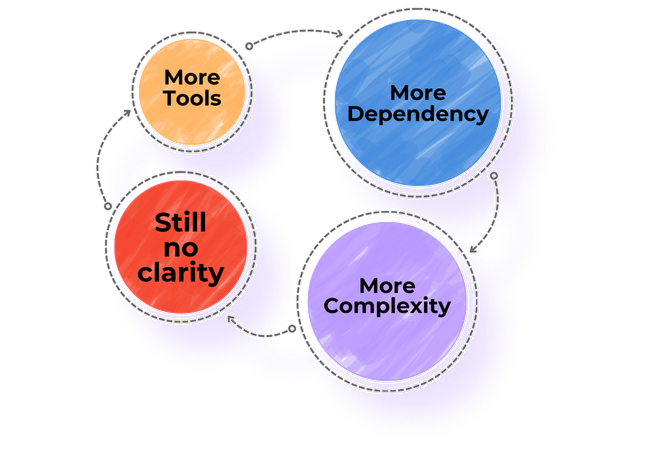
Adding tools without systems increases dependency and confusion.

Where automation fits

(and where it doesn’t)
Automation is not a starting point. It is a consequence of clarity.
When systems are clear:
Checkmark
Automation becomes obvious
Checkmark
Workflows simplify
Checkmark
Software choices narrow
When systems are unclear:
Cross
Automation fragments
Cross
Exceptions multiply
Cross
Founders stay involved

When businesses actually need systems

Most businesses don’t need systems on day one.
Systems
Revenue grows but effort grows faster
People
More people coordinate daily work
Follow-up
Follow-ups feel inconsistent
Individual
Decisions depend on a few individuals
At this stage, execution alone stops working.
The constraint becomes structure.

Why diagnosis matters before decisions

Before investing in systems, hires, or tools, you need to understand the current structure.
+
New hires increase coordination cost
+
New tools increase dependency
+
New processes add friction

A final note on clarity

Well-designed systems make businesses predictable
Work moves without someone pushing it
Checkmark
New people fit in without things breaking
Checkmark
The founder can step back without things stopping
That works — until it doesn’t.
Without predictability, everything relies on people compensating for structure.

15 minutes. No pitch. You leave knowing exactly where the gaps are.